It's old news, if it's news at all. But TV's Craig Ferguson, host of CBS's "The Late Late Show" recently gave details of his Harley Davidson V-ROD crash, in England. He's an experienced motorcyclist, and owner of an Indian motorcycle. But apparently on a visit to England several years ago, he rented a HD V-ROD, and wrecked it.
He mentioned the accident on his show recently, when the topic of cracked ribs came up in conversation.
In his words, "The Harley V-ROD doesn't like to turn." Then, apparently thinking better of disparaging the product of a potential sponsor, he said, "Okay, it was my fault."
"I was going around a corner and I turned, and the bike didn't. I broke three ribs and my collar bone. And it was springtime in England, and I discovered I had pollen allergies. Let me tell you, sneezing with broken ribs is a good way to invent new cuss words."
Like a true comedian, he turned his misfortune into laughs for the audience. And like a true corporate guy, he deflected the produce defamation into self-deprecation, for the sake of the corporations involved.
The cracked rib discussion appears at about 4:45 into this segment on YouTube.
But if truth be told, I think he's right about the bike. Following my own test drive of the V-Rod last year, I didn't give it points for handling or comfort.
Of course, Craig rightly also blames himself. Shame on him, as a rider on an unfamiliar bike, for putting himself into a position where he was outside his skill level. Next time he jumps on a rental, I bet he'll make allowances for the differences in the handling and performance of the bike. He'll be careful!

Showing posts with label Harley Davidson. Show all posts
Showing posts with label Harley Davidson. Show all posts
Practicality And Style
"And I didn't even have to bungee it down!" said Mrs. Rat.
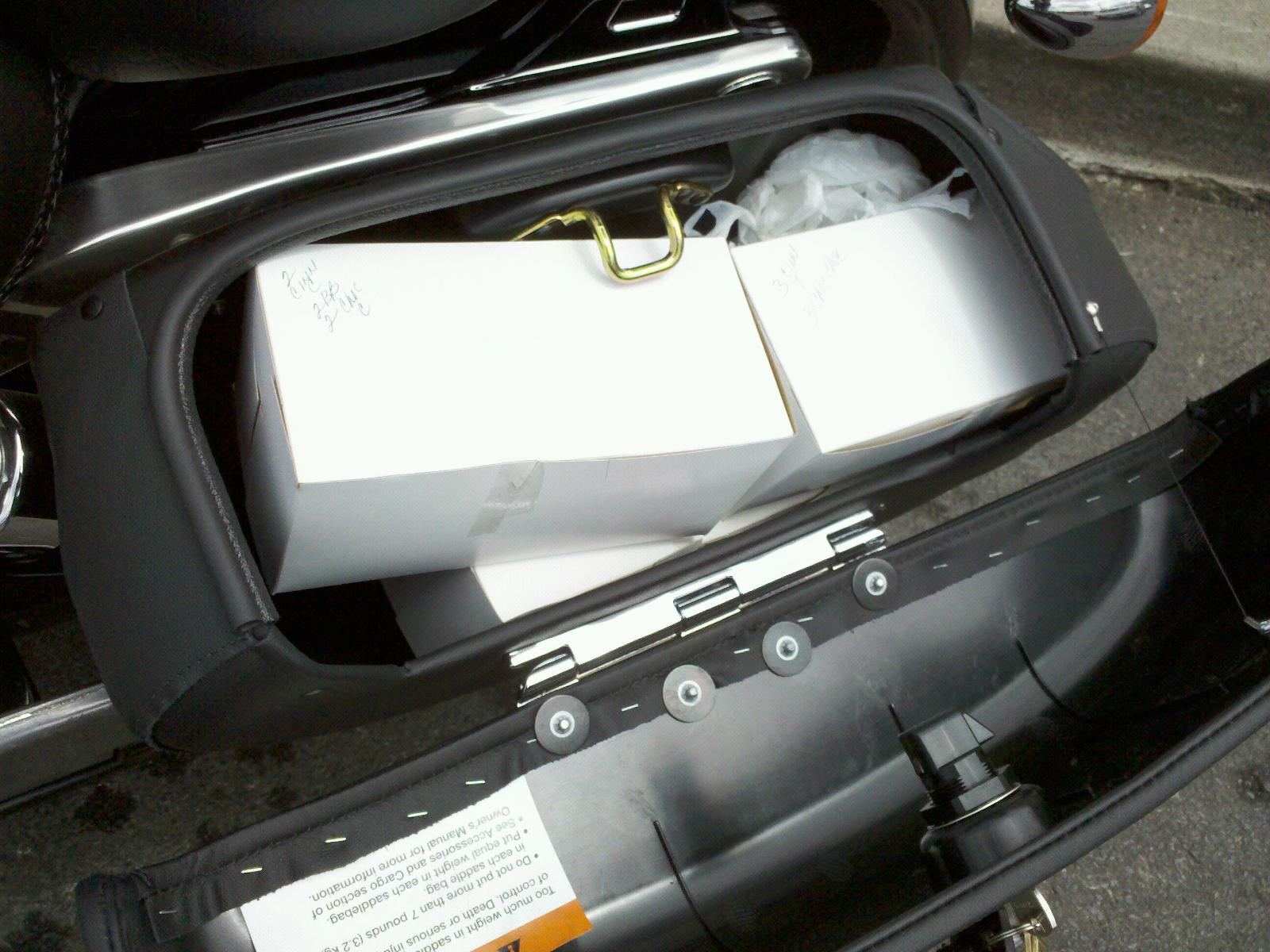
Mrs. Rat ran a few errands on her Harley Davidson Super Glide today, and was thankful for the deceptively capacious rigid saddlebags I had installed for her earlier this year.
She was able to fit two dozen donuts in one saddlebag, not having to resort to strapping cargo on the pillion seat.
Some folks feel bags detract from cruiser aesthetics. We Rats are passed that . . . we embrace the aesthetic of usability.

If it's worth doing right, it's worth doing over
After installing saddlebags, and relocating the turn signals on my wife's Dyna Super Glide, (see my earlier post, "I'm not a very good mechanic") I simply wasn't satisfied with the wiring job on the turn signals.
The stock wiring from the original turn signals was frayed when I first inspected it. It was probably installed that way at the factory. It caused no problems in the original fender-mounted configuration, but when I rerouted the wiring through the metal "license-plate mounted" turn signal stem, the fraying caused the turn signals to short out. So I had to splice the wires very close to where they emerged from the stem. The proximity to the stem and the fender made splicing, soldering, and heat wrapping the wires very nerve racking and tedious. I got it done, but the resulting splices were pretty sloppy, and I'm not sure they were waterproof.
I decided to rewire them today, knowing I could do a better job of splicing and sealing the wires if I did the splicing on the workbench, instead of on the bike.
I did exactly that, and ended up with neatly sealed and waterproofed splices. The only way to accomplish this, since the properly spliced and wrapped wires were too fat to run through the stem, was to run the wires outside the turn signal stem. This freed up enough space to properly splice and wrap the wires.
Purists may object to the "wired" look, preferring the hidden wiring of the original design. But in my case, since the stock wires were frayed to begin with, I would've had to buy new turn signals, with a new, intact, unfrayed wiring harness, in order to route them through the stem.
If I ever have to replace the rear turn signals, that's what I'll do. But in the meantime I have a properly wired, properly waterproofed wiring harness which does the job, and looks good. Well, it looks as good as it can for wires running outside the stem.
The stock wiring from the original turn signals was frayed when I first inspected it. It was probably installed that way at the factory. It caused no problems in the original fender-mounted configuration, but when I rerouted the wiring through the metal "license-plate mounted" turn signal stem, the fraying caused the turn signals to short out. So I had to splice the wires very close to where they emerged from the stem. The proximity to the stem and the fender made splicing, soldering, and heat wrapping the wires very nerve racking and tedious. I got it done, but the resulting splices were pretty sloppy, and I'm not sure they were waterproof.
I decided to rewire them today, knowing I could do a better job of splicing and sealing the wires if I did the splicing on the workbench, instead of on the bike.
I did exactly that, and ended up with neatly sealed and waterproofed splices. The only way to accomplish this, since the properly spliced and wrapped wires were too fat to run through the stem, was to run the wires outside the turn signal stem. This freed up enough space to properly splice and wrap the wires.
Purists may object to the "wired" look, preferring the hidden wiring of the original design. But in my case, since the stock wires were frayed to begin with, I would've had to buy new turn signals, with a new, intact, unfrayed wiring harness, in order to route them through the stem.
If I ever have to replace the rear turn signals, that's what I'll do. But in the meantime I have a properly wired, properly waterproofed wiring harness which does the job, and looks good. Well, it looks as good as it can for wires running outside the stem.
I'm not a very good mechanic
I'm not a very good mechanic. This should come as no surprise to anyone. I've never boasted of my mechanical abilities. I had never turned a wrench, never so much as changed oil in my own car, before I owned a motorcycle. But owning a motorcycle has changed that.
When I started in the world of motorcycling, I had no spare cash. I scraped together $1000 bucks by selling crap out of my attic, and bought a 20 year old Honda on eBay.
Having no money, and a 20-year-old bike, and wanting to ride it -- those were the formula for learning how to wrench on my own bike. It was borne of necessity.
So along the way I've learned a thing or two. Changed my own oil. Rebuilt brakes. Cleaning and balancing carburettors. Basically, when something broke, that's when I learn how to fix it. Because I had no choice. I can't wheel a 20 year old bike to a mechanic and ask them to fix it. Most shops won't take bikes that old. And I couldn't afford their prices if they did.
So I learned.
Fast forward to today.
It's not a 20-year-old bike I'm working on. It's a one-year-old Harley Davidson I bought for my wife last year. It's not broken down, I'm just adding accessories.
But once again, budgetary reality plays a role in my mechanical training. I bought saddlebags for her 2009 Dyna Super Glide, and along with them, the requisite turn signal relocation kit.
The Harley Dealer wanted three hours of labor, at $95.00 per hour, to install the bags and relocate the turn signals.
That was half-again the price I'd spent on the accessories. I could save a lot if I did it myself. And it didn't look too complicated, compared to, say, rebuilding and balancing, (and reinstalling!) the Magna's four-barrel carburettor.
But I knew at least enough to carve out plenty of time to do the work. If it takes a trained Harley mechanic three hours to do it, it'll take me longer. At least the first time.
I was right about that.
Relocating the turn signals was the first step. The kits instructions were pretty good, and I managed to relocate the turn signals in about an hour.
It involved:
I was pleased to note that, contrary to the instructions, I did not have to drill a hole through the stock fender in order to rewire the turn signals. Harley was smart enough to drill a hole in the stock fender, cleverly plugged with a plastic cap and hidden beneath the stock license plate mount. This pre-drilled hole was perfectly positioned for use with the turn-signal relocation kit. This little bit of foresight on Harley's part took some of the stress out of the job for me, as I was worried about drilling through the fender. Though I can drill through metal easy enough, I have the right tools for it, I feared a slip of the hand would result in a scratched fender, or a punctured tire.
One unexpected snag I hit was the stock wiring harness was frayed. Right where the stock wires pass through the retaining clips under the fender, the wires were frayed through the insulation. I decided to make my splice there, at the location where the wires were already frayed, which was the "correct" spot. According to the instructions, I should cut the wires 4 to 6 inches from the turn signal housing.
In retrospect, I wish I'd made the cuts in a different place. By cutting and splicing the wires where I did, my splices, and the requisite shrink-wrap sleeve which hides my soldering joints, sits above the fender, right behind the license plate. The solder joints themselves are frustratingly close to the point where the wires emerge from the license-plate mounted stems.
If I had it to do again, I'd have made the splice closer to the plug end of the wires. The splices would have been beneath the fender. I imagine Harley wanted the splice to be out of the way of the wheel spray and gunk which happens under the fender.
From there I tackled the saddlebag installation.
If I had it to do over again, having learned what I've learned in the process, it would have taken me an hour, and I wouldn't have broken a sweat.
Ah, but the learning process, getting from "I've never done this before" to "I know how to do this" was a 3 and a half hour journey, fraught with sweating and cursing.
What should've been a simple job was complicated because I misunderstood the directions. The saddlebag installing kits are multi-fit, meaning they fit a variety of models of bikes from a variety of years. There are extra spacers and miscellani that are included in the kit, and the instructions carefully outline which assortment of spacers are used in which configuration for your specific bike.
It's actually pretty well laid out and easy to follow.
But I missed a piece. I misread a statement which lead me to attempt, which great frustration, to install the saddlebags with the stock under-fender bracket. After wasting a lot of time with this -- the bolts simply would not seat properly -- I noticed the new under-fender brackets which had been included with the kit, quietly waiting to the side. I re-read the directions and discovered my error. I had missed that sentence about my particular model and year requiring the new under-fender bracket.
Once this error was discovered, the saddlebags were on the bike in less than half an hour.
As I said, I'm not a very good mechanic, because a good mechanic would've realized "there must be something wrong here" much sooner, and a very good mechanic wouldn't have made the error to begin with.
But at the end of the day I was successful. I got the turn signals relocated and the saddlebags installed. I didn't kill anybody or damage anything. I saved the household budget the $285 in labor that would've been paid to the Harley mechanic to do this job.
And I learned.
When I started in the world of motorcycling, I had no spare cash. I scraped together $1000 bucks by selling crap out of my attic, and bought a 20 year old Honda on eBay.
Having no money, and a 20-year-old bike, and wanting to ride it -- those were the formula for learning how to wrench on my own bike. It was borne of necessity.
So along the way I've learned a thing or two. Changed my own oil. Rebuilt brakes. Cleaning and balancing carburettors. Basically, when something broke, that's when I learn how to fix it. Because I had no choice. I can't wheel a 20 year old bike to a mechanic and ask them to fix it. Most shops won't take bikes that old. And I couldn't afford their prices if they did.
So I learned.
Fast forward to today.
It's not a 20-year-old bike I'm working on. It's a one-year-old Harley Davidson I bought for my wife last year. It's not broken down, I'm just adding accessories.
But once again, budgetary reality plays a role in my mechanical training. I bought saddlebags for her 2009 Dyna Super Glide, and along with them, the requisite turn signal relocation kit.
The Harley Dealer wanted three hours of labor, at $95.00 per hour, to install the bags and relocate the turn signals.
That was half-again the price I'd spent on the accessories. I could save a lot if I did it myself. And it didn't look too complicated, compared to, say, rebuilding and balancing, (and reinstalling!) the Magna's four-barrel carburettor.
But I knew at least enough to carve out plenty of time to do the work. If it takes a trained Harley mechanic three hours to do it, it'll take me longer. At least the first time.
I was right about that.
Relocating the turn signals was the first step. The kits instructions were pretty good, and I managed to relocate the turn signals in about an hour.
It involved:
- unbolting the stock turn signals from their fender-mounted stems,
- cutting the plugs on the end of the turn signal wires,
- unthreading the wires from the stock stems,
- rethreading the wires through the new license-plate mounted stems,
- re-soldering the wires.
I was pleased to note that, contrary to the instructions, I did not have to drill a hole through the stock fender in order to rewire the turn signals. Harley was smart enough to drill a hole in the stock fender, cleverly plugged with a plastic cap and hidden beneath the stock license plate mount. This pre-drilled hole was perfectly positioned for use with the turn-signal relocation kit. This little bit of foresight on Harley's part took some of the stress out of the job for me, as I was worried about drilling through the fender. Though I can drill through metal easy enough, I have the right tools for it, I feared a slip of the hand would result in a scratched fender, or a punctured tire.
One unexpected snag I hit was the stock wiring harness was frayed. Right where the stock wires pass through the retaining clips under the fender, the wires were frayed through the insulation. I decided to make my splice there, at the location where the wires were already frayed, which was the "correct" spot. According to the instructions, I should cut the wires 4 to 6 inches from the turn signal housing.
In retrospect, I wish I'd made the cuts in a different place. By cutting and splicing the wires where I did, my splices, and the requisite shrink-wrap sleeve which hides my soldering joints, sits above the fender, right behind the license plate. The solder joints themselves are frustratingly close to the point where the wires emerge from the license-plate mounted stems.
If I had it to do again, I'd have made the splice closer to the plug end of the wires. The splices would have been beneath the fender. I imagine Harley wanted the splice to be out of the way of the wheel spray and gunk which happens under the fender.
From there I tackled the saddlebag installation.
If I had it to do over again, having learned what I've learned in the process, it would have taken me an hour, and I wouldn't have broken a sweat.
Ah, but the learning process, getting from "I've never done this before" to "I know how to do this" was a 3 and a half hour journey, fraught with sweating and cursing.
What should've been a simple job was complicated because I misunderstood the directions. The saddlebag installing kits are multi-fit, meaning they fit a variety of models of bikes from a variety of years. There are extra spacers and miscellani that are included in the kit, and the instructions carefully outline which assortment of spacers are used in which configuration for your specific bike.
It's actually pretty well laid out and easy to follow.
But I missed a piece. I misread a statement which lead me to attempt, which great frustration, to install the saddlebags with the stock under-fender bracket. After wasting a lot of time with this -- the bolts simply would not seat properly -- I noticed the new under-fender brackets which had been included with the kit, quietly waiting to the side. I re-read the directions and discovered my error. I had missed that sentence about my particular model and year requiring the new under-fender bracket.
Once this error was discovered, the saddlebags were on the bike in less than half an hour.
As I said, I'm not a very good mechanic, because a good mechanic would've realized "there must be something wrong here" much sooner, and a very good mechanic wouldn't have made the error to begin with.
But at the end of the day I was successful. I got the turn signals relocated and the saddlebags installed. I didn't kill anybody or damage anything. I saved the household budget the $285 in labor that would've been paid to the Harley mechanic to do this job.
And I learned.
Harley Test Drive: XR1200
My friends and I took a Harley test drive recently, and I wrote my review of the V-Rod Muscle. Dennis shares his thoughts on the XR1200.
Says Dennis:
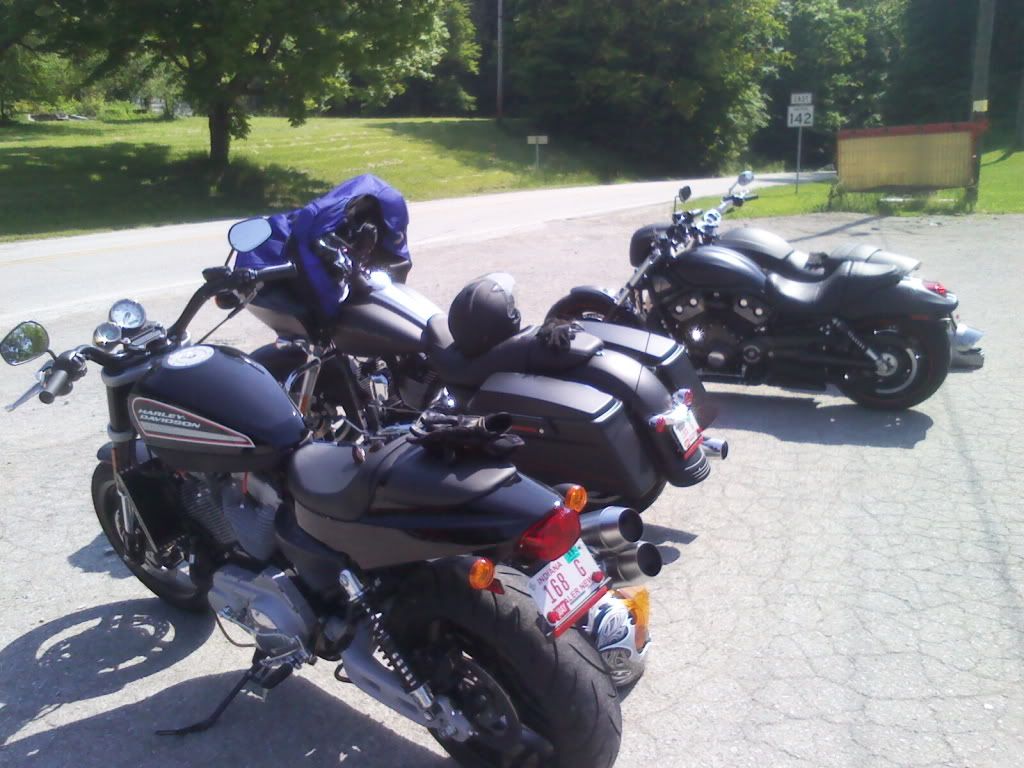
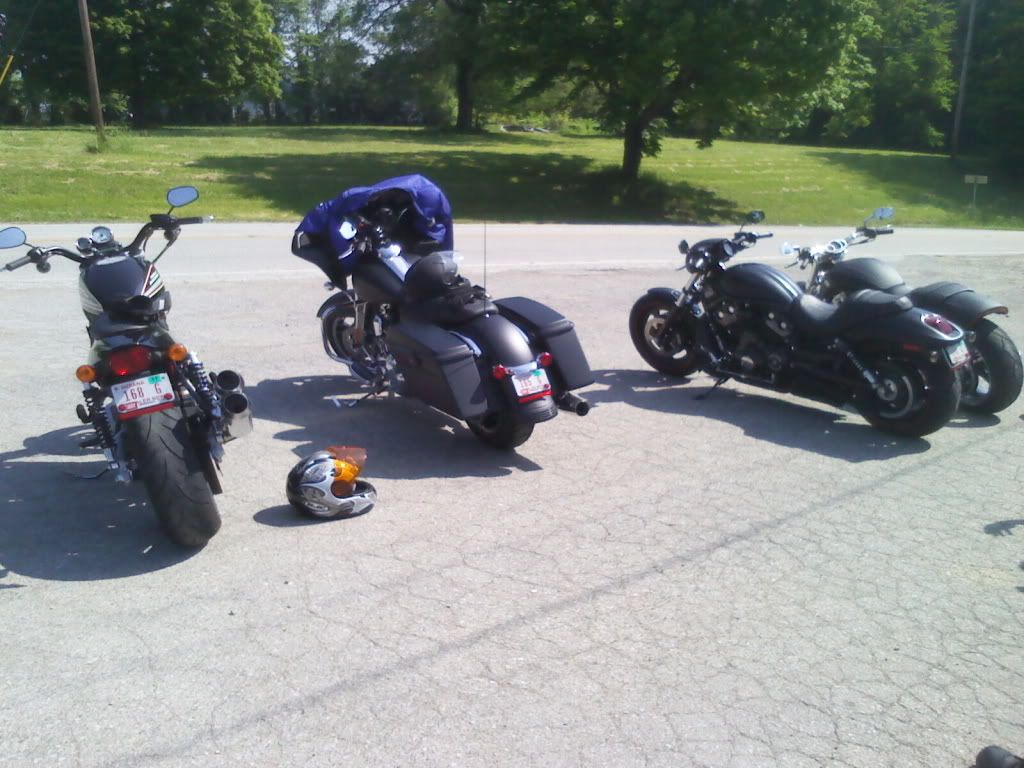
Dennis snapped a few photos of the four bikes we test drove. From left to right, the V-Rod Muscle, The (V-Rod) Night Rod, the Tour Glide and the XR1200.

Another view, showing another angle of the XR1200.

The XR1200 from behind.

Says Dennis:
My usual ride is a Dual-sport Suzuki DR650. This was the second time on the XR. I like it. The power is useable from low rpm to the 7500 rpm redline.
It is a little heavy on slow turns but speed up just a touch and a little counter steer and she will hug the turns.
The seat height is very low and the seat IS comfortable. The pegs are mid mounted, right where god intended them to be!
I like this bike and could live with it being my only ride. It is fun. I would miss the off road versatility of dual sport though.
Here are my 3 didn't likes:
- The turn signal switches on both handles. I hate that.
- The rear suspension doesn't have too much travel and can be harsh on bumpy Indiana roads. But it is better than the Nightster.
- This is a weird one. The engine was too smooth. Yes, I just said that about a HD Sportster engine. It was fuel injected and fairly quite of pipe. I HAD to use the tach to know when to shift/down shift. I am used to doing that by the seat of my pants. You just couldn't feel it on the XR.
I am going to stick with my DR650, frankly I think my DR is faster 0 - 60. Now I just need to get a Kawi dealer to let me take out a Versys!
Thanks HD for the test ride!
Dennis snapped a few photos of the four bikes we test drove. From left to right, the V-Rod Muscle, The (V-Rod) Night Rod, the Tour Glide and the XR1200.
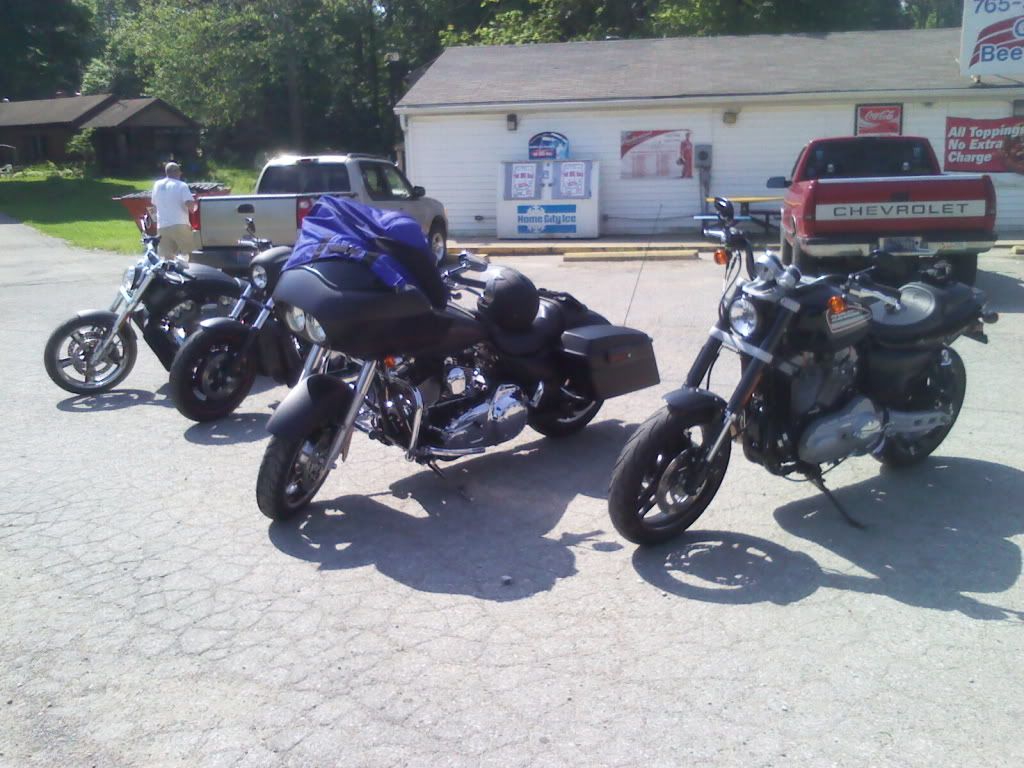
Another view, showing another angle of the XR1200.
The XR1200 from behind.
Harley Test-Drive: V-Rod Muscle
My riding buddies and I signed up for a Harley Davidson test drive today. Harley is sponsoring this test drive event called "Super Ride - Lead Yourself Into Temptation". Unlike your typical HD test drive, they give you the keys to the bike and you can go where you like, unescorted by dealership staff.
The four of us signed up to ride and the same time. Brian chose a Tour Glide,
Dennis chose an XR1200. Bob and I both wanted to ride the V-Rod Muscle, but they only had one. He was kind enough to agree to switch to a Night Rod Special.
I like the looks of the Muscle, so I focused on it for a few shots. It's the bike in the center, and it features symmetrical pipes, which I prefer. All other V-Rods have right-side-only exhaust. You can see Bob's "Night Rod" after-market Vance & Hines 2-into-1 shorty exhaust on the bike on the left. And you get another shot of the Tour Glide on the right.
The V-Rod Muscle features a front cowl over the neck and triple tree that is distinctive from all other V-Rod derivatives. You can see it here as it appears "bolted" on in front of the "gas tank" (which isn't a tank at all). I'm not really a fan of the look, but it does set it apart from the other V-Rods.
Satin finish exhaust pipes, as opposed to the typical shiny chrome finish, set this bike apart from the others as well.
Just wanted to illustrate the symmetical exhaust - one pipe on each side of the bike. Somehow that seems right to me.
The dealer asked each of us to sign a waiver, then gave us an overview of the bike's controls before turning us loose. We hopped on the interstate for a quick 10 mile jaunt to the next exit. We exited onto SR 39 south, through Monrovia. This is one of our favorite roads.
With the Night Rod's after-market exhaust, everyone could hear when Bob rolled on the throttle. With a loud crack, the bike would jump forward. In a few seconds he was out of sight.
I was improessed with the motor, transmission and suspension on the V-Rod Muscle. But if I had to choose one word to describe my test drive, it would be this:
OUCH!
Willie G. Davidson, what the hell were you thinking? This is a horribly uncomfortable seating position. Imagine the top half of your body leaning forward, like you were riding a sport bike. Now imagine the bottom half of your body reaching forward, like you were riding a cruiser. Here you are, bent in the middle at less than a 90 degree angle, like you're riding some sort of medieval torture device. And how the heck can you design a bike so that you can see the front wheel while you're riding down the road. The front wheel was so far out there, I was checking the front tread at 70 mph (posted Interstate speed limit, thank you very much.)
And the first time I had to turn it, I thought it never was gonna turn. Very slow into the corners, and it took some persuasion to initiate the lean. This got better as the ride went on, as I developed a feel for the bike and what it took to lean it.
Once I got the hang of how to turn it -- with a firm grip on the bar and a decisive push -- the suspension was rock solid as a threw the bike through the twisties.
The torque curve also took some getting used to. Most other Harley's I have ridden had so much grunt down low, you could practically take off from a dead stop by letting the clutch out at idle. It would get the bike going with only the slightest encouragement from the throttle. With the V-Rod, I had to rev it up in order to pull away. I didn't have to rev it like a sport bike, but unlike any other cruiser I've ever ridden.
Once I got used to the power delivery, I was amazed at the breadth of the power band. A Harley with a tachometer, and a (nearly) 10,000 rpm redline! That really is the oddball of the Harley family.
We stopped at a gas / beer/ bait store in some off-the-map location, amidst twisty roads. It was a hot day, some bought gatorade to keep hydrated.
I snagged a photo of Dennis snagging a photo of the XR1200.
The two V-Rods parked side by side. Bob's "Night Rod" on the left, the "Muscle" on the right.
From here we turned back and retraced our steps to the dealership. To my surprise, they didn't try any arm twisting or coercion tactics. The friendly sales rep talked to each of us about what we liked about the bike. Some of us asked about available options - different handlebar configuration, different seats, or anti-lock brakes. We were each entered in a contest to win a gift card or a free motorcycle, and each of us walked out with a brochure and the salesman's business card.
And they let us go at that.
Not a bad way to spend a morning.
As for the V-Rod Muscle, I'm giving it a thumbs down because of the seating position. The day Harley puts mid-mount controls and/or serious pull-back risers on the bike, I'll give it a serious look.
The four of us signed up to ride and the same time. Brian chose a Tour Glide,

Dennis chose an XR1200. Bob and I both wanted to ride the V-Rod Muscle, but they only had one. He was kind enough to agree to switch to a Night Rod Special.

I like the looks of the Muscle, so I focused on it for a few shots. It's the bike in the center, and it features symmetrical pipes, which I prefer. All other V-Rods have right-side-only exhaust. You can see Bob's "Night Rod" after-market Vance & Hines 2-into-1 shorty exhaust on the bike on the left. And you get another shot of the Tour Glide on the right.

The V-Rod Muscle features a front cowl over the neck and triple tree that is distinctive from all other V-Rod derivatives. You can see it here as it appears "bolted" on in front of the "gas tank" (which isn't a tank at all). I'm not really a fan of the look, but it does set it apart from the other V-Rods.

Satin finish exhaust pipes, as opposed to the typical shiny chrome finish, set this bike apart from the others as well.

Just wanted to illustrate the symmetical exhaust - one pipe on each side of the bike. Somehow that seems right to me.

The dealer asked each of us to sign a waiver, then gave us an overview of the bike's controls before turning us loose. We hopped on the interstate for a quick 10 mile jaunt to the next exit. We exited onto SR 39 south, through Monrovia. This is one of our favorite roads.
With the Night Rod's after-market exhaust, everyone could hear when Bob rolled on the throttle. With a loud crack, the bike would jump forward. In a few seconds he was out of sight.
I was improessed with the motor, transmission and suspension on the V-Rod Muscle. But if I had to choose one word to describe my test drive, it would be this:
OUCH!
Willie G. Davidson, what the hell were you thinking? This is a horribly uncomfortable seating position. Imagine the top half of your body leaning forward, like you were riding a sport bike. Now imagine the bottom half of your body reaching forward, like you were riding a cruiser. Here you are, bent in the middle at less than a 90 degree angle, like you're riding some sort of medieval torture device. And how the heck can you design a bike so that you can see the front wheel while you're riding down the road. The front wheel was so far out there, I was checking the front tread at 70 mph (posted Interstate speed limit, thank you very much.)
And the first time I had to turn it, I thought it never was gonna turn. Very slow into the corners, and it took some persuasion to initiate the lean. This got better as the ride went on, as I developed a feel for the bike and what it took to lean it.
Once I got the hang of how to turn it -- with a firm grip on the bar and a decisive push -- the suspension was rock solid as a threw the bike through the twisties.
The torque curve also took some getting used to. Most other Harley's I have ridden had so much grunt down low, you could practically take off from a dead stop by letting the clutch out at idle. It would get the bike going with only the slightest encouragement from the throttle. With the V-Rod, I had to rev it up in order to pull away. I didn't have to rev it like a sport bike, but unlike any other cruiser I've ever ridden.
Once I got used to the power delivery, I was amazed at the breadth of the power band. A Harley with a tachometer, and a (nearly) 10,000 rpm redline! That really is the oddball of the Harley family.
We stopped at a gas / beer/ bait store in some off-the-map location, amidst twisty roads. It was a hot day, some bought gatorade to keep hydrated.
I snagged a photo of Dennis snagging a photo of the XR1200.
You can see the photos Dennis took, and read his Test Drive Report here.

The two V-Rods parked side by side. Bob's "Night Rod" on the left, the "Muscle" on the right.
By the way, Bob test drove a V-Rod Muscle last year and gave it a favorable review.

From here we turned back and retraced our steps to the dealership. To my surprise, they didn't try any arm twisting or coercion tactics. The friendly sales rep talked to each of us about what we liked about the bike. Some of us asked about available options - different handlebar configuration, different seats, or anti-lock brakes. We were each entered in a contest to win a gift card or a free motorcycle, and each of us walked out with a brochure and the salesman's business card.
And they let us go at that.
Not a bad way to spend a morning.
As for the V-Rod Muscle, I'm giving it a thumbs down because of the seating position. The day Harley puts mid-mount controls and/or serious pull-back risers on the bike, I'll give it a serious look.
2010 Harley-Davidson Wide Glide
Motorcycle USA reviewed the reborn, 2010 Harley Davidson Wide Glide.
Throttle Lock Stupidity
Some idiotic bonehead decided to lock the throttle (i.e. cruise control) and ride his bike while standing on the passenger boards. He was doing this stupid stunt while traveling past women and children. Luckily none of them were hurt, but his ego probably isn't quite intact along with his bike and the car that it ran into.
Caution: Harsh language
"I'm gonna lock the throttle lock"
Sneak Peek: 2010 Buell Blast

Buell introduced their 2010 models just like the Motor Company, but they're showing the Blast after having been through the crusher.
They issued a press release: "We’ve turned a limited number of Blasts into colorful metal cubes, each numbered and signed by Erik Buell himself"
Full article at kneeslider.com
Revisiting the V-Rod Muscle
| About The Author | |
|---|---|
| Bob contributed a report after his brief, 5-mile test drive of the 2009 Harley Davidson V-Rod Muscle. The bottom line was ... not worth the hefty price tag. But while on vacation in Vermont, he had a chance to put the bike through its paces on some fantastic roads. You'll see by the following trip report -- he changed his tune.... |  |
Yesterday I took one hell of a Harley test drive. I called the Harley shop over in Barre, VT to inquire about renting a VRod muscle for a few days. They didn't have any on the rental program, but would be glad to let me take one out for a few hours for free.

Beauty. So I drove 44 miles down to the shop and picked up a brand new, shiny V-Rod Muscle. I rode it up I-89 to the Stowe exit - highway 100. I took highway 100 up past the Ben & Jerry's factory and some other landmarks to Stowe, VT. From Stowe I rode up 108 through "Smuggler's Notch", stopping along the way to take some pictures. 108 is a curvy, hilly piece of road; a royal pain in the ass in a minivan, but amazing on the V-Rod.
Over the notch and around 50 miles later, I showed the bike to my wife and her parents. Initially the plan was for me to take her for a quick, scenic spin through the notch, drop her off, and head back to the dealership. Well, my wife loved the bike and ended up riding all the way back to Barre with me. This is the longest trip we've ever taken together and it was a blast!
All in all I rode the bike around 100 miles on some of the most scenic roads you can imagine.
I am a certified V-Rod Muscle fan and a Harley convert. I plan to buy one within the next 5 years. I may even sell the Magnaceptor.
Great Motorcycle Ad

The female rider applies make-up. Instead of a mirror, she uses her reflection in the air filter cover on her Harley Davidson Dyna.
The text of the ad sums up her attitude.
"Do this. Do that. Don't do this. Don't do that. Blah blah blah."
I'm tired of doing what folks tell me to do. I'm going to ride.
This ad resonates with its audience, and evokes the classic "Wild Ones" motorcyclist-as-rebel aura. It also shows that motorcycle riders can be feminine.
Test Drive: Harley-Davidson V-Rod Muscle
Friend and former coworker Bob recently test drove the Harley Davidson V-Rod Muscle, and had this to say:
The V-Rod Muscle is a bad-ass bike.
One thing I noticed is that when you're on the bike, you can't see much of it.
The seating position is odd -- I kind of felt like an ape sitting on it.
In the riding position the parts you can see don't look that cool. But it sounds cool. At stop lights it has a very pleasing rumble and vibration - like a dragster ready to rip through a quarter mile.

My bike [The Magnaceptor -- Ed.] is smooth as butter at idle. Sometimes I can't tell it's running. Boring! The V-Rod has a low, mean growl at full throttle, and plenty of torque.This bike surprisingly had great brakes (dual rotors out front, single rotor in rear). It was heavy and not nearly as nimble as the Magnaceptor. I found it hard to swerve, and different to turn due to the low, drag-style handlebars. This is a good bike in a straight line.
I loved it, but would like it to be more nimble. Its a great cruiser, and would make a nice commuter.
That V-Rod muscle was BAD, but the $19000+ wasn't.
The V-Rod Muscle is a bad-ass bike.
One thing I noticed is that when you're on the bike, you can't see much of it.
The seating position is odd -- I kind of felt like an ape sitting on it.
In the riding position the parts you can see don't look that cool. But it sounds cool. At stop lights it has a very pleasing rumble and vibration - like a dragster ready to rip through a quarter mile.

My bike [The Magnaceptor -- Ed.] is smooth as butter at idle. Sometimes I can't tell it's running. Boring! The V-Rod has a low, mean growl at full throttle, and plenty of torque.This bike surprisingly had great brakes (dual rotors out front, single rotor in rear). It was heavy and not nearly as nimble as the Magnaceptor. I found it hard to swerve, and different to turn due to the low, drag-style handlebars. This is a good bike in a straight line.
I loved it, but would like it to be more nimble. Its a great cruiser, and would make a nice commuter.
That V-Rod muscle was BAD, but the $19000+ wasn't.
| About The Author | |
|---|---|
| Bob has been riding, fixing, and modifying motorcycles since his youth. He has ridden a variety of bikes over the years. Last year he whiled away the winter months by transplanting the motor from a Honda Interceptor into his Honda Magna. He calls the new creation "The Magnaceptor". This is his first contribution to "The ATGATT Rat" | |
Mustang Back Support
I couldn't abide the stock Honda seat on my 3rd Gen Magna, so I upgraded to a Mustang two-up Saddle.
 It is comfortable on the underside, I can ride all day without getting a sore butt, but it does seem to promote an unhealthy slouch.
My wife made the same observation about her Mustang seat ... more comfortable than stock but does something adversely affecting posture. Stock for her was a solo seat, which wouldn't do, and is why we went with Mustang.
Both of us have cruiser-style bikes (I realize I may have eliminated 3/4 of the list with that demographic...) one sabmag and one HD.
Both of us have similar requirements ... two up seating (we each ride our own, and occasionally take one of our children with us). And healthy back posture for the driver.
 Anybody fought this battle and have some helpful tips? I've looked at Mustang's with driver backrest, and from the looks of them (but haven't sat in one) it seems the driver backrest would be too far back to provide the needed support.
I guess I need to find someone who has one to test sit, or pony up the dosh for a purchase from www.DennisKirk.com -- who has apparently a free-return policy which I haven't tested out but seems promising. But I would have to pony up full retail price for such an experiment.
Any thoughts/suggestions would be appreciated.
 It is comfortable on the underside, I can ride all day without getting a sore butt, but it does seem to promote an unhealthy slouch.
My wife made the same observation about her Mustang seat ... more comfortable than stock but does something adversely affecting posture. Stock for her was a solo seat, which wouldn't do, and is why we went with Mustang.
Both of us have cruiser-style bikes (I realize I may have eliminated 3/4 of the list with that demographic...) one sabmag and one HD.
Both of us have similar requirements ... two up seating (we each ride our own, and occasionally take one of our children with us). And healthy back posture for the driver.
 Anybody fought this battle and have some helpful tips? I've looked at Mustang's with driver backrest, and from the looks of them (but haven't sat in one) it seems the driver backrest would be too far back to provide the needed support.
 I guess I need to find someone who has one to test sit, or pony up the dosh for a purchase from www.DennisKirk.com -- who has apparently a free-return policy which I haven't tested out but seems promising. But I would have to pony up full retail price for such an experiment.
Any thoughts/suggestions would be appreciated.
Test Drive: 2009 Harley Davidson XR1200
Ryde4Ever submits this test drive report
What is the difference between the XR1200 and the Nightster 1200? It is like night and day! (Pun intended).
Since I recently rode a Nightster (see the test drive report) there will be some comparisons.
Today I rode an orange 2009 XR1200 at the local Harley dealership. Very nice people!
 I had talked to one of the salesmen last week and he said, "Sure we have a couple XR1200s. Call me some morning and we will set you up for the afternoon."
This was part of the Super Ride, test ride any bike on the floor promotion.
Unlike one of the other HD dealers that only allowed a ride on demo days and in a group, this deal lets you ride solo without any supervision.
I went about 11 miles. Mostly within the speed limit, but a couple secluded areas let me hit around 70 mph.
The seat is still low enough for my 30" inseam to fit and touch the ground with both feet. It is very comfortable, much better than the Nightster. It is taller than the other Sportsters but not too much. The pegs are right below you where they should be, in my opinion.
Fit and finish was typical HD, excellent!
The reach to the handlebars is less of a reach than on the Nightster. It has an analog tach and a digital speedo. Both are very easy to read even in bright sunlight. The turn signals are typical HD on both handles, but they are self-canceling.
The engine is fuel injected and starts up instantly and runs smooth. It vibrates a lot at idle, but I don't think it is as bad as the Nightster. As soon as the engine hits about 2200 rpm, it smooths out.
I did notice a few more vibes through the pegs on this one but only at lower RPMs. It is funny; while slowing, somewhere around 2200-2300 you notice the tingle, kind of like the bike is saying, "Ok, you can down shift now."
This bike is great! It is exactly the type of Harley that I would gladly own. It has amazing torque at any speed.
In fact, so much that it is a bit touchy at the throttle. Me, not being used to the turn signal switch on the right side, accidently twisted the throttle a touch while trying to turn on the signal. The kick about threw me off the bike. The 5-speed transmission was smooth as silk, just like the Nightster's.
The amazing thing: this bike LIKES to turn! It feels good leaning way over. And no scraping of miscellaneous parts when doing so.
 Turn on the power mid-turn and it just hunkers down and tells you to lean a bit further.I also noticed the front brakes really work well. Not much front end dive when you hit them.
I am used to riding a tallish 360 lb (wet) dual sport bike. I easily hopped on this much heavier bike and felt pretty comfortable in a few miles. I barely noticed the extra weight. It is wider but just felt right. The air filter doesn't seem to hammer your right knee like on the Nightster.
There is also much more rear suspension travel. Most normal bumps are absorbed. Some of the bigger ones are still a bit jarring. But, nothing like the Nightster.
Acceleration felt similar to the Nightster. My DR650 could probably stay right with this bike up to about 60, then that XR would leave me sitting.
Positives:
Negatives:
What is the difference between the XR1200 and the Nightster 1200? It is like night and day! (Pun intended).
Since I recently rode a Nightster (see the test drive report) there will be some comparisons.
Today I rode an orange 2009 XR1200 at the local Harley dealership. Very nice people!
 I had talked to one of the salesmen last week and he said, "Sure we have a couple XR1200s. Call me some morning and we will set you up for the afternoon."
This was part of the Super Ride, test ride any bike on the floor promotion.
Unlike one of the other HD dealers that only allowed a ride on demo days and in a group, this deal lets you ride solo without any supervision.
I went about 11 miles. Mostly within the speed limit, but a couple secluded areas let me hit around 70 mph.
The seat is still low enough for my 30" inseam to fit and touch the ground with both feet. It is very comfortable, much better than the Nightster. It is taller than the other Sportsters but not too much. The pegs are right below you where they should be, in my opinion.
Fit and finish was typical HD, excellent!
The reach to the handlebars is less of a reach than on the Nightster. It has an analog tach and a digital speedo. Both are very easy to read even in bright sunlight. The turn signals are typical HD on both handles, but they are self-canceling.
The engine is fuel injected and starts up instantly and runs smooth. It vibrates a lot at idle, but I don't think it is as bad as the Nightster. As soon as the engine hits about 2200 rpm, it smooths out.
I did notice a few more vibes through the pegs on this one but only at lower RPMs. It is funny; while slowing, somewhere around 2200-2300 you notice the tingle, kind of like the bike is saying, "Ok, you can down shift now."
This bike is great! It is exactly the type of Harley that I would gladly own. It has amazing torque at any speed.
In fact, so much that it is a bit touchy at the throttle. Me, not being used to the turn signal switch on the right side, accidently twisted the throttle a touch while trying to turn on the signal. The kick about threw me off the bike. The 5-speed transmission was smooth as silk, just like the Nightster's.
The amazing thing: this bike LIKES to turn! It feels good leaning way over. And no scraping of miscellaneous parts when doing so.
 Turn on the power mid-turn and it just hunkers down and tells you to lean a bit further.I also noticed the front brakes really work well. Not much front end dive when you hit them.
I am used to riding a tallish 360 lb (wet) dual sport bike. I easily hopped on this much heavier bike and felt pretty comfortable in a few miles. I barely noticed the extra weight. It is wider but just felt right. The air filter doesn't seem to hammer your right knee like on the Nightster.
There is also much more rear suspension travel. Most normal bumps are absorbed. Some of the bigger ones are still a bit jarring. But, nothing like the Nightster.
Acceleration felt similar to the Nightster. My DR650 could probably stay right with this bike up to about 60, then that XR would leave me sitting.
Positives:
- Engine and tranny
- Seating position
- Handling and braking. Did I mention great handling?
Negatives:
- Throttle is a bit touchy
- Still a bit rough on very bumpy roads
- Price $10,799 in black and $11,079 in orange
| About the author | |
|---|---|
Dennis has been known to haunt various dual-sport websites under the nom de plume Ryde4Ever. He's ridden dirt bikes since emerging from the womb, and has owned everything from Ninjas to Vulcans to Chinese dirtbikes. He doesn't brag about his riding ability, but could quietly ride circles around most riders on the road, including yours truly, The ATGATT Rat. His current steed is a Suzuki DR650. |  |
Test Drive: 2007 Harley Davidson Dyna Street Bob

We found a Harley Davidson dealership that allows test drives (not all of them do) so we paid them a visit. My wife wanted to try a FXDWG - Dyna Wide Glide. They had none on the showroom floor, so we picked something similar, an FXDB -- Dyna Street Bob. This one had the narrow wheel up front, the 96 cubic inch motor, after market pipes, and ape hangers.
I hesitate to write a report about a customized bike -- the pipes were not stock. But since this is a common customization -- it seems like everyone who buys one of these bikes puts on after-market pipes -- it seems a relevant review.
I had expected a dealer-escort along a four mile course. Instead, the kid handed us the keys, and told us not to be out too much past 4. It was 2:45. He pointed us toward a twisty road and said have fun.
We rode for about 45 minutes out of town up an old twisty road.
After that amount of time, my ears were ringing. The vibration was not as bad as I had heard or imagined. Rubber mounted engine, I guess. I could feel the vibration in the hand grips.
The power and throttle response was worse than I had expected. I would describe the performance as Lackluster. I've heard it said that a Harley engine "Turns gasoline into noise and vibration with the least amount of power imaginable."
[See Editor's Note, below]
Backfiring on deceleration, for a moment it reminded me of the Magna before I cleaned the carbs. Makes me wonder whether there really was a problem with the fuel injection mapping. I know that the fuel injection has to be modified when custom pipes are installed. Looks like they didn't quite get it right.
I'll never know how much of the power and performance problems were related to faulty fuel injection mapping, and how much was simply "as good as it gets". I'll have to test drive other bikes - perhaps with stock fuel injection mapping and stock pipes - to be sure.
Back to the dealer, they debriefed us on our ride, and tried to urge us toward a purchase. They knew we were in the "early planning stages" of my wife's next bike, and that there would be no bike-buying today. They had my wife pick out her favorite color, talked about finance options, yada yada yada. Very low key, not hard sell tactics.
"What did you think of the Street Bob?" they asked her.
"Too loud," she said.
"What about you?" they asked me.
"Not enough power, too sluggish." I replied.
Editor's Note: This review was lifted from a longer post of mine, in which I reviewed several different bikes and also gave an account of the trip there and back.
Also, I should note as a follow-up, the problems I describe in this bike, including the unfair cliche about Harley-Davidson noise-to-power ratio, seem to have been caused either by the after-market pipes, or the fuel-injection mapping, or both. The stock 2009 Harley Davidson Dyna Super Glide, which has the same engine and same chassis, didn't exhibit any of this behavior.
Test Drive: 2009 Harley Davidson Night Rod

Friend and fellow rider Brian also participated in the recent Harley Demo Day at South Side Harley. He rode the Night Rod Special.
His report: "Pretty much the same configuration as the VRSCAX I rode last year, except a funky little shield above the panel, and that black and orange paint job.
His report: "Pretty much the same configuration as the VRSCAX I rode last year, except a funky little shield above the panel, and that black and orange paint job.

"I liked it a lot. Haven't ridden cruiser style much, so it took me half the ride to figure how to get my feet of the ground.
"Had lots of power, and wasn't Harley loud."
Musings on the nature of Motorcycle Reviews...
Brian is pretty laconic in his review, but it still contained some useful information. As the owner of a BMW R1150R, Brian's favorable review of the power is noteworthy. It helps to know where the author is coming from. If it had been reviewed by someone whose regular ride was a VT500 shadow, I'd say the reviewer would be "easier to impress" in the power department than the author whose regular ride is a larger, more powerful bike.
Regular reviewers, professional authors who ride bikes and write about it for a living, are able to draw from a wider basis of comparison than your average rider. But, I imagine, it helps to know the biases or the preferences of the author when reading their review. Those are a little harder to discern. Journalists strive for objectivity, or the appearance thereof, though as humans we cannot help but retain, at our core, simple, subjective feelings that color -- to some extent -- even our so-called objective reports.
Back to the example at hand, Brian's not really a Harley fan. He's happy to have as his daily ride, something different than the plentiful Harley cruiser. So, for him to overcome this neutral or slightly negative view of Harley Davidson to write favorable remarks about the Night Rod -- this also says something.
It must be good. They must be doing something right. To lure someone who typically would not consider a Harley Davidson into test driving the bike, and afterwards, to have only positive things to say.
Will this translate into sales for Harley Davidson? Penetration of a new market segment? That is their hope for the V-Rod line. Will it work?
A Little Bit Of History

Carolyn and her dad riding the big Harley in 1978. Start 'em young!

Carolyn and her dad by the big Harley in the mid-80's.

Carolyn rides the big Harley in 2002.
 Finally, Carolyn rides her own, April 2009
Harley Test Drive

South Side Harley Davidson hosted a "test ride day" recently. Dennis posted an excellent write-up on the Nightster 1200 he test drove that day. He recently passed along a photo that was taken of him that day.
"What out!" he said, "Beware of the bada$$ on the Nightster."
If you knew Dennis, you'd recognize the irony. He's not into the whole "Harley Rider as rebel" scene. He rides on and off road, sold his cruiser 'cause it was too sedate. He could quite literally ride circles around me.
I prefer reports from real riders -- like Dennis -- to the marketing material distributed by the manufacturers. AutoMotoPortal.com basically posted the Harley Davidson Nightster Brochure on their site. Well written prose, of course, but not nearly as informative as a first hand account.
Test Drive: 2009 Harley Davidson Nightster 1200
Ryde4Ever files this test ride report:

This is no knock on the bike, but it brought back memories of the Vulcan 500 that I "had. It was a very nice bike to ride, but there was a "fun" factor that was missing. That was part of why I sold it and didn't ride for a year or so. I think that would happen to me again if I rode the Nightster all of the time. The "fun" would slip away.
"It was a group ride with one of the [dealership employees] leading the group. I think it was about 10 bikes. A mix of various Harley and Buell models.
"I rode the 1200 Nightster. The seat was nice and low. The bars upright and the pegs in the standard position, right were they are supposed to be, in my opinion . It felt a little funny because the bike is a lot wider between my legs than what I am used to.


"Fuel injection is great. Started right up, no fuss and ran flawless. They had a loop mapped out, probably 10 miles that went down some 2 lane back roads and ended with a stretch on the interstate.
"One thing that kept going through my head. This is the rubber mounted motor?
All the magazine articles talk about how much better the Sportster is with the rubber motor mounts. My gosh, that thing about gave me double vision at the stop lights, it vibrated so much at idle. It really did remind me of a paint shaker. Once under way it wasn't bad but stopped it was really bad. It makes my thumper feel smooth.
"Here are my pluses and minuses:
Pluses
- Plenty of power and torque. Very easy to get moving and from about 50 mph up it was much quicker than I am used to. But the V-Rod would still pull away from me quickly even if I was at full throttle.
- Excellent transmission and clutch. I have to say that it was probably the smoothest shifting bike that I have ever ridden.
- The seating position was comfortable. Upright and no strange stretching for my arms or legs. The pegs are closer to the seat than on my bike. If you were much taller than me, it might be a bit cramped.
- All of the controls worked well. The turn signals were self canceling. Nice feature. The clutch was easy and smooth.
Minuses
- The seat was hard as a rock. This might not have been a problem if it weren't for the next point.
- The rear suspension felt like it had maybe an inch of travel. When that big rear tire hit a bump, the jolt goes right up the spine. I felt my fillings in my teeth rattle!
- The real deal-breaker for me was cornering clearance. There weren't any "Pumpkin Vine" type of turns on this ride and I am glad there wasn't. I am used to just dropping my bike into most turns. Never a second thought about anything touching. I think it was like the third stop sign that we came to. It was a right hand turn. I noticed that I was a bit wide as I was turning so I leaned a touch more. Scrunch!! What the...? I had just ground the right peg into the asphalt. You gotta be kidding me. I would have to slow down my riding style significantly on the twisty back roads. At the rest of the right hand turns I felt like I had to ride it like a tricycle. Keep it vertical and actually turn the bars in the direction that I wanted to go. Noooo! I want lean and counter steer.
My conclusion
"The Nightster is a well built, very cool looking bike. Great straight line speed and stability. Smooth controls and shifting. If you are the type of rider that cruises around town or rides country roads with sweeping turns at a modest pace. It would be a great bike for that (but would need a different seat).
"But if you have a bit of hooligan in you and you like to pretend to SuperMoto or MotoGP, it is not the bike for that.
This is no knock on the bike, but it brought back memories of the Vulcan 500 that I "had. It was a very nice bike to ride, but there was a "fun" factor that was missing. That was part of why I sold it and didn't ride for a year or so. I think that would happen to me again if I rode the Nightster all of the time. The "fun" would slip away.
"I am going to see if I can get a ride on the Harley Davidson XR1200. At least it can corner. :-)
"One last thing, I really believe that from 0-60 that I would be able to stay right with it on my DR. After that the HD's bigger motor would start pulling away."
More from Dennis at the DR Rider's Forum
| About the author | |
|---|---|
Dennis can be found riding dirt bike trails with his son, or haunting various dual-sport websites using the name "Ryde4Ever". He has ridden dirt bikes since emerging from the womb, and has owned everything from Ninjas to Vulcans to Chinese dual-sports. These days he rides a Suzuki DR650. This is his first article for "The ATGATT Rat". | |
More from Dennis at the DR Rider's Forum
Subscribe to:
Posts (Atom)